
'Urjit Patel's appointment is a right decision and in the interest of the country.'
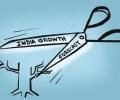
India's real GDP growth will decline marginally to 6.3 per cent in 2024 from the 6.4 per cent estimated for 2023, an American brokerage firm said on Monday. The next calendar year will be of two halves, wherein the government spending before the upcoming General Elections will be the key driver for growth, while after the elections, it will be the re-acceleration in investment growth, especially from the private sector, Goldman Sachs said in a report. From a fiscal year perspective, the brokerage said it expects growth to accelerate to 6.5 per cent for FY25 from the 6.2 per cent it has projected for the ongoing FY24, it added.

Most economists feel the RBI has room for a 25-basis point cut, having met inflation targets comfortably

ITC stock slipped over 4 per cent on Thursday (February 8) after British American Tobacco (BAT) said it could sell some of its stake in the company, recovering partially in trade. The stock of the cigarette-to-hotels conglomerate traded at Rs 420 levels, rising 1.3 per cent in intraday deals as compared to the S&P BSE Sensex that traded flat for most part of the day. The development, meanwhile, saw Jefferies downgrade the stock to 'hold' from 'buy' earlier with a target price of Rs 430, down a huge 17.3 per cent from its earlier price target of Rs 520.

Referring to the proposed new monetary policy framework, it said in the weeks ahead, government and RBI will work towards it.

Consumer prices rose an annual 5.11 per cent (2012 base) in January.

'The consensus was that the debate was between looking backward and looking forward.' 'Trump, with his great enamourment of his own 'achievements,' was obviously looking backward, while Harris, nearly 20 years his junior, was focussing on the future, with hope,' notes Shreekant Sambrani.

Wall Street-correlated stock markets are facing the risk of correction, as Christopher Wood, the global head of equity strategy at Jefferies, conveys to investors in his latest edition of GREED & fear. Rising crude oil prices, which are nearing $100 a barrel (Brent), pose a threat to the global central bank's battle against inflation and have led to a re-evaluation of its exposure to Indian stocks. "The potential for more US Federal Reserve (Fed) rate hikes, combined with the risk that monetary tightening finally bites as regards the economy, remains a risk for Wall Street-correlated world stock markets. "There is also the oil factor. This is why GREED & fear continues to believe the pain trade is down. "Areas in Asia, such as Indian midcaps, which have already done very well, are at obvious risk of some profit-taking," writes Wood.

Raghuram Rajan, who has been pilloried by his critics for keeping interest rates high and has also been accused of stifling growth.

The RBI, which has been keeping rates at an elevated level citing the high inflation, wants to bring it down to 6 per cent by January 2016.

The Reserve Bank of India on Thursday opted for a pause second time in a row, maintaining key benchmark policy rate at 6.5 per cent as inflation moderates. The rate increase cycle was paused in April after six consecutive rate hikes aggregating to 250 basis points since May 2022. Announcing the bi-monthly monetary policy, RBI Governor Shaktikanta Das said the Monetary Policy Committee (MPC) unanimously decided to keep the rate unchanged at 6.5 per cent.

'Data-dependence means you can raise or drop rates. The present stance is only for raising rates.'

The RBI has targeted 6 percent inflation by January 2016
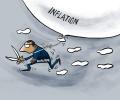
'If all goes well, we may well hit or even surpass the forecast growth rate.'

Everyone is worried about inflation making their money worth less or even worthless.

Rajan added "many" market participants were convinced that India could hit the RBI's target of bringing down consumer inflation to 6 percent by January 2016.
.jpg)
Improved investor sentiment is expected to drive the economy forward in the coming quarters.

An immediate RBI rate cut will lower lending rates for banks' MSME/retail/mortgage loans before the 'busy' industrial season ends in March.

The Reserve Bank's rate-setting panel, Monetary Policy Committee (MPC), began its three-day deliberations on Wednesday amid expectations of a status quo on benchmark rate mainly on account of uncertainty over the impact of the second wave of COVID-19 pandemic. Moreover, the fears of firming inflation may also refrain the MPC from tinkering with the interest rate in its bi-monthly monetary policy outcome to be announced on Friday. The RBI had kept key interest rates unchanged at the last MPC meeting held in April.

Achieving inflation target of 4 per cent, recovery after remonetisation and hardening profile of oil prices are some of the risks which the RBI is watching closely, says Gaurav Kapur.
Rs 5,000 crore additional liquidity facility to be provided by the National Housing Bank to boost liquidity in housing sector, the RBI said.
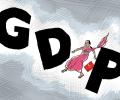
India's economy continues to be robust, but downside risks such as rising crude oil prices, adverse weather conditions, and the global banking crisis outweigh the upside potential in gross domestic product (GDP) growth in the current financial year (FY24), the finance ministry said on Tuesday in its Monthly Economic Review for March. "We reiterate that downside risks to our official forecast of 6.5 per cent for real GDP growth in FY24 dominate upside risks," the review said. "Opec's surprise production cut has seen oil prices rise in April, off their lows of low-seventies per barrel in March.

While the BJP said it has only portrayed some incidents, which happened during the previous Congress regime through the cartoons which are not meant to hurt anyone, the grand old party accused it of releasing such illustrations out of frustration.
RBI is expected to cut policy rates by 50 basis points by 2016.
The RBI expects inflation in 2015 to hover around 6 per cent -- its target for January 2016 -- and sees risks to the target evenly balanced.

On the back of sound macroeconomic policies and softer commodity prices, India's growth momentum is likely to be sustained in 2023-24 in an atmosphere of easing inflationary pressures, said the Reserve Bank's annual report released on Tuesday. It, however, added that slowing global growth, protracted geopolitical tensions and a possible upsurge in financial market volatility following new stress events in the global financial system could pose downside risks to growth. "On the back of sound macroeconomic policies, softer commodity prices, a robust financial sector, a healthy corporate sector, continued fiscal policy thrust on quality of government expenditure, and new growth opportunities stemming from global realignment of supply chains, India's growth momentum is likely to be sustained in 2023-24 in an atmosphere of easing inflationary pressures," it said.

Will the 6 per cent inflation target be met?

The banking system liquidity bounced back to surplus mode after three weeks, the Reserve Bank of India (RBI) data showed. This was due to government spending, according to dealers. The liquidity situation could further ease with the disbursement of the last tranche of incremental cash reserve ratio (I-CRR) worth Rs 50,000 crore on Saturday.

RBI seen cutting repo rate 25 bps on Sept 29, says a poll

Analysts are expecting inflation to fall further in October and November on base effect. Inflation measured by consumer prices has been trending down for over four months, and came in at 6.7 per cent in September.
Inflation may come down to RBIs projections, if it does not we will have to take steps, RBI deputy governor K C Chakrabarty said on the sidelines of an event organised by Confederation of Indian Industry and Suresh Neotia Centre of Excellence.
.jpg)
Narrowing of the current account deficit will help arrest depreciation of the rupee and ease inflation concerns, industry groups said.

Government and the Planning Commission had earlier projected a growth rate of 9 per cent during 2011-12, up from 8.6 per cent in the previous fiscal.

'I am shocked that the BJP makes so many commitments. What did they deliver as the NDA?'
As inflation rate is near the upper limit of the comfort zone, experts rule out rate cuts anytime soon

Mohit, Noor, Rashid, Cummins: Whose bowling impressed you?

Food prices probably fueled a sharp rise in India's retail inflation in December after the record low struck the previous month.

The Reserve Bank on Wednesday hiked key benchmark policy rate by 25 basis points to 6.5 per cent, citing sticky core inflation. This is the sixth time interest rate has been hiked by the Reserve Bank of India (RBI) since May last year, taking the total quantum of hike to 250 basis points. Announcing the bi-monthly monetary policy, RBI Governor Shaktikanta Das said the Monetary Policy Committee (MPC) by a majority decided to raise the policy repo rate by 25 basis points and keep a 'strong vigil' on inflation outlook.

RBI Governor Raghuram Rajan, who today surprised markets with a rate hike, defended the move saying a rate cut would not have impacted either banks or borrowers and that bringing down retail prices is the key to sustainable growth.

CPI inflation is on the decline since July.
